DCWF Scientific Symposium

DCWF Scientific Symposium

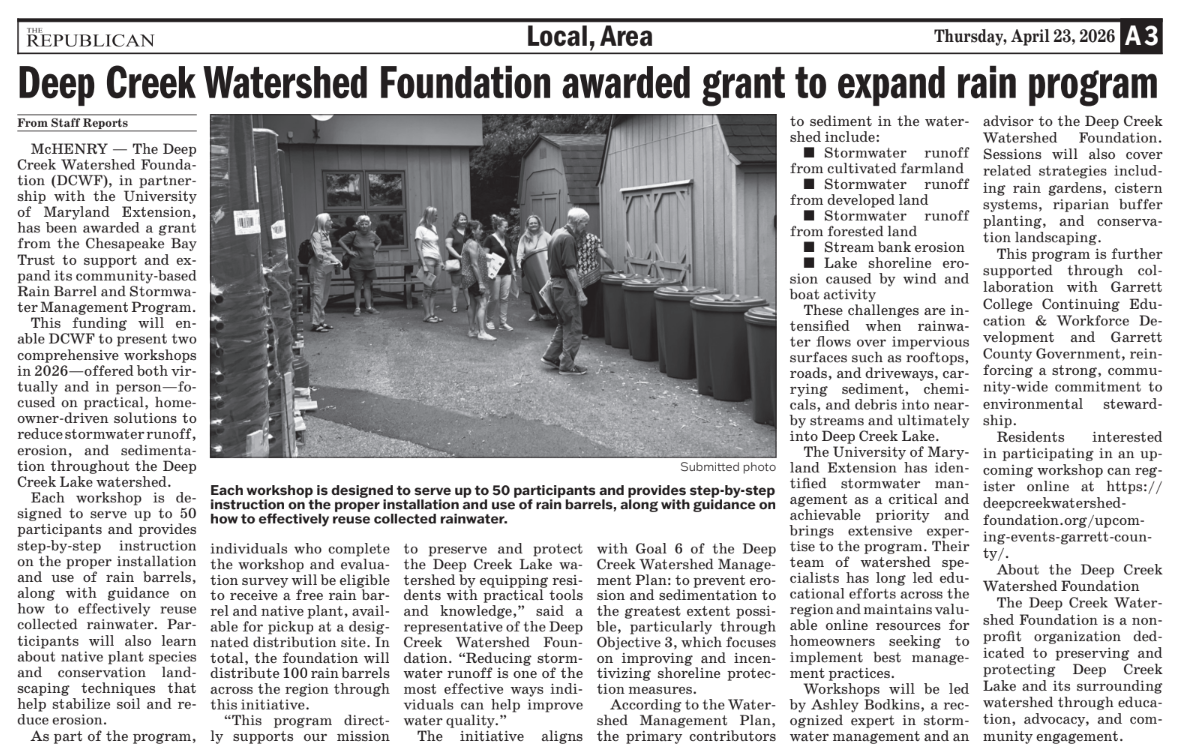
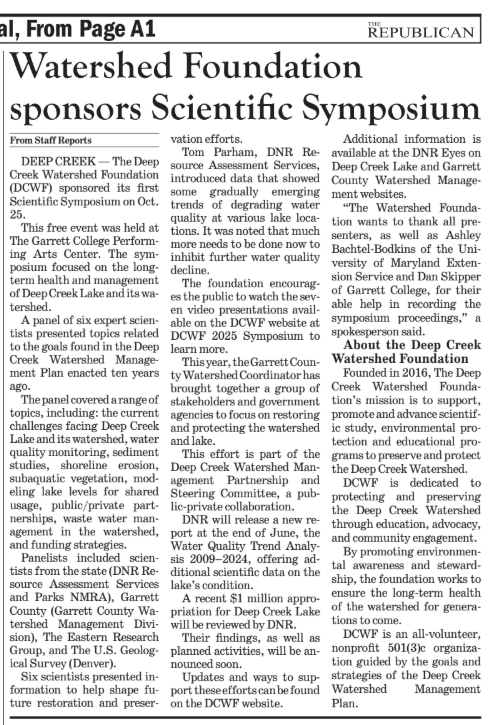
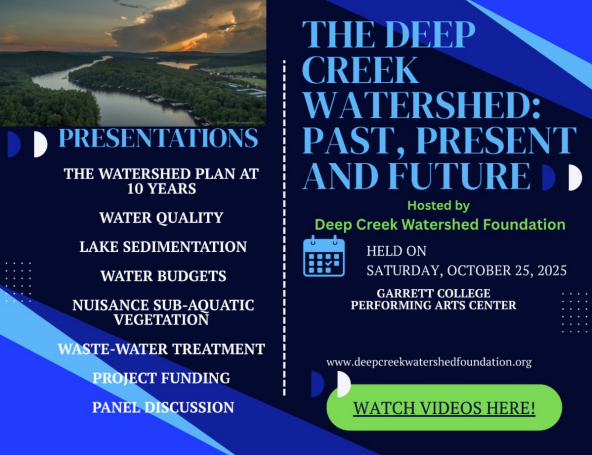
On October 25th, 2025, THE DEEP CREEK WATERSHED FOUNDATION (DCWF) sponsored its first SCIENTIFIC SYMPOSIUM. This free event was held at The Garrett College Performing Arts Center. The Symposium focused on the long-term health and management of Deep Creek Lake and its watershed. A panel of six expert scientists presented topics related to the goals found in the Deep Creek Watershed Management Plan enacted ten years ago. The panel covered a range of topics, including:

  • The current challenges facing Deep Creek Lake and its watershed
  • Water quality monitoring
  • Sediment studies
  • Shoreline erosion
  • Sub aquatic vegetation
  • Modeling lake levels for shared usage
  • Public/Private partnerships
  • Waste water management in the watershed
  • Funding strategies

Panelists included scientists from the State (DNR Resource Assessment Services and Parks NMRA), Garrett County (Garrett County Watershed Management Division), The Eastern Research Group, and The U.S. Geological Survey, (Denver). Six scientists presented valuable information that will shape future restoration and preservation efforts. Tom Parham, DNR Resource Assessment Services, introduced data that showed some gradually emerging trends of degrading water quality at various lake locations. All agreed that much more needs to be done now to inhibit further water quality decline.

The foundation encourages you to watch the seven video presentations available on the DCWF website at DCWF 2025 Symposium to learn more. You can watch all seven presentations or select the ones of most interest to you. This year, the Garrett County Watershed Coordinator has brought together a group of stakeholders and government agencies to focus on restoring and protecting the watershed and lake. This effort is part of the Deep Creek Watershed Management Partnership and Steering Committee, a public-private collaboration. DNR will release a new report at the end of June, the Water Quality Trend Analysis 2009–2024, offering additional scientific data on the lake’s condition. A recent $1 million appropriation for Deep Creek Lake will be reviewed by DNR and their findings as well as planned activities will be announced soon. Look for updates and ways you can support these important efforts on the DCWF website. Additional information is available at DNR Eyes on Deep Creek Lake and Garrett County Watershed Management websites. 

The Watershed Foundation wants to thank all presenters, as well as Ashley Bachtel-Bodkins of the University of Maryland Extension Service and Dan Skipper of Garrett College for their able help in recording the symposium proceedings.

ANNOUNCING the Water Wise Kids Zone 

The Deep Creek Watershed Foundation is excited to announce a brand-new addition to our website — the Water Wise Kids Zone! This fun and educational section is designed especially for elementary-aged children to learn about the importance of protecting our water, wildlife, and natural habitats. Through hands-on activities, kids can explore the wonders of the Deep Creek Watershed while discovering how small actions can make a big difference for the environment.

In the Water Wise Kids Zone, young nature enthusiasts will find printable coloring pages, an engaging scavenger hunt, entertaining videos, and much more! Each activity encourages curiosity and environmental stewardship in a way that’s both fun and meaningful. Whether at home, in the classroom, or on the shores of Deep Creek Lake, the Water Wise Kids Zone offers families an exciting way to help the next generation connect with — and care for — the watershed we all love. Click here for the Water Wise Kid Zone: 

Water Wise logo

Deep Creek Lake Tributary Bioassessment

Deep Creek Lake Tributary Bioassessment

Background

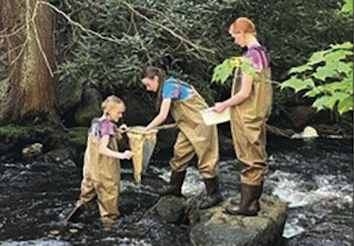
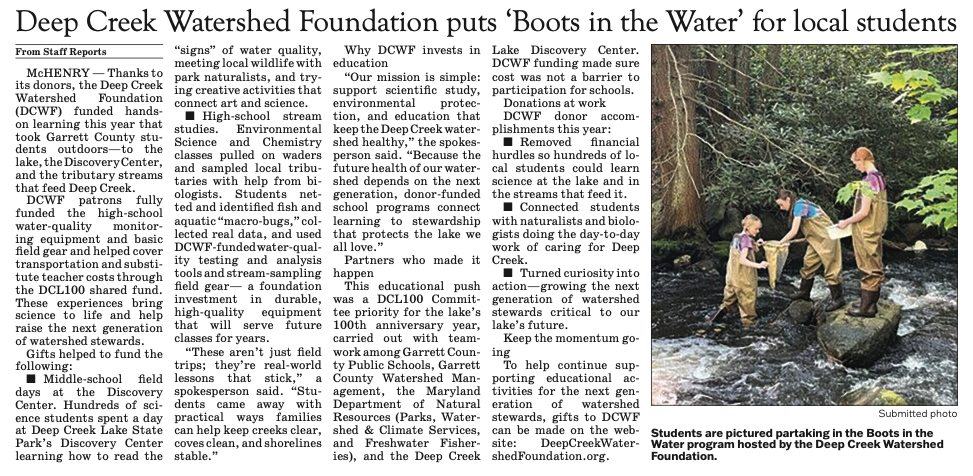
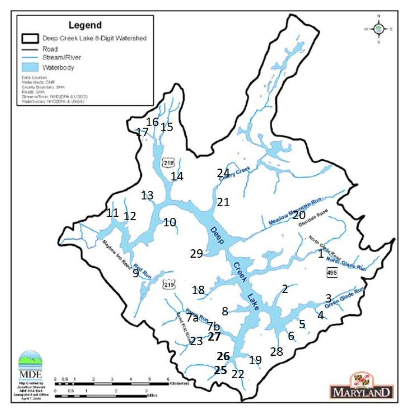
In July 2022, the Deep Creek Watershed Foundation contracted a team from PennWest – California to conduct a synoptic bioassessment of 29 perennial Deep Creek Lake tributaries at sites selected by the Deep Creek Watershed Foundation. Overall, results described cool water streams that exhibit measurable total alkalinity and generally possess good chemical water quality. However, sediment buildup on stream bottoms resulted in lower than expected macroinvertebrate and fish abundance.

In July 2025, the Foundation contracted the same team from PennWest – California to conduct another synoptic bioassessment of the same 29 tributaries, and one additional location, to better understand how tributary water quality and habitat has changed over time at Deep Creek Lake. The total contract amount for the 2022 and 2025 study work was $27,725, and was funded via private donations to the Foundation. This effort partially fulfills Goal 3 of the Deep Creek Watershed Management Plan.

Purpose

The 2022 study served as a preliminary baseline of tributary water quality and habitat. This study assisted the Foundation in identifying potential projects that help to preserve and protect the watershed over the last three years. The 2025 tributary study provides updated data that can be compared to the data collected in 2022, and other previous data collection efforts, to better understand how water quality and habitat in the tributaries surrounding Deep Creek Lake have changed over time.

Key Takeaways

  • Water quality within the tributaries sampled is generally good with approximately neutral pH and Total Dissolved Solids (TDS) concentrations well below 500 ppm, the acceptable limit for drinking water.
  • 360 fish were collected from 15 different species, across 21 of the 30 tributaries sampled. These fish were primarily Blacknose Dace, Creek Chub, and Yellow Bullhead. Brook Trout (Smith Run), Muskellunge, Largemouth Bass, Yellow Perch, and Walleye were also among the fish assessed. Fish diversity and abundance increased between the 2022 and 2025 study.
  • During macroinvertebrate sampling, 546 individuals from 32 taxa were collected across 21 stations. Crayfish were the most commonly collected macroinvertebrate.
  • While chemical water quality is generally good and supports aquatic life, macroinvertebrate and fish aquatic habitat continue to be poorly impacted by the buildup of sediment on the streambank floor, potentially related to human impacts such as residential and commercial building.

Next Steps

The Foundation has shared the tributary study reports with Maryland Department of Natural Resources, Maryland Department of the Environment, and the Garrett County Public Health Department for their awareness and potential use. The Foundation will continue to perform future tributary studies to track water quality and habitat changes over time. The Foundation will continue to work to identify potential projects based on the results of the 2025 report.

Tributary Sampling Locations

Tributary Sampling Locations

Tributary Reports & Resources


Deep Creek Lake 100 Golf Classic a Swinging Success at Thousand Acres Golf Club

DCL 100 Golf Classic

PRESS RELEASE
For Immediate Release

Deep Creek Lake 100 Golf Classic a Swinging Success at Thousand Acres Golf Club Swanton, MD — The Deep Creek Lake 100 Golf Classic, held on Tuesday, July 8 at the stunning Thousand Acres Golf Club in Swanton, MD, brought together 96 golfers for a day of spirited competition, community camaraderie, and charitable giving. The sold-out event marked a major success for the Deep Creek Watershed Foundation’s centennial celebration of Deep Creek Lake.
 
The tournament was part of a larger celebration honoring the 100th anniversary of Deep Creek Lake. Festivities began the evening before with the DCL100 Kickoff ParTee at the beautiful Red Barn Inn, where guests enjoyed a festive Low Country Seafood Boil catered by Ace’s Run and lively, crowd-pleasing New Orleans-style jazz music by the Sugarfoot Stompers. The kickoff set the tone for a memorable and meaningful two-day celebration.
 
Under sunny skies and surrounded by breathtaking mountain and lakeside views, golfers competed across 18 challenging holes. Special contests kept things lively, and a number of standout performances were recognized:
 
Contest Winners:
  • Shortest Drive – Women #1: Peggy Alexander

  • Closest to the Pin – Men #3: Finley Wampler (Northern High School Golf Team)

  • Longest Drive – Hole #8: Bill Weisgerber

  • Longest Drive – Women #11: Frannie Fagan

  • Closest to the Pin – Women #17: Terri Bosse

Top Finishing Teams:
  • 1st Place (-13 / 59): Matt Kelly, Travis McCann, Bob Holcomb, Elliott Perfetti

  • 2nd Place (-10 / 62): Mike Freiman, Steve Freiman, Adam Freiman, Bill Franklin

  • 3rd Place (-8 / 64): Donald Hawk, Tom Harshberger, Mike Farris, Craig Yutzy

The Deep Creek Lake 100 Golf Classic was more than just a great day on the course—it supported ongoing efforts to preserve and protect the Deep Creek Watershed. The event was part of a broader series of celebrations recognizing the 100th anniversary of Deep Creek Lake.
 
Special thanks go to the staff at Thousand Acres Golf Club, the volunteers, sponsors, and all participants for making this tournament an unforgettable highlight of the summer.  The key sponsors included Thousand Acres Golf Club, Law Offices of Phillips & Allen PA and Liz and Don Morin. The Morins hosted teams for both Northern and Southern high school golf teams. Thanks to all the local businesses who also supported this wonderful tournament!
 
Media Contact:
Deep Creek Watershed Foundation
Sandy Bello
sbello2524@gmail.com
240 321-2524

Lake Water Level Management Tool

Lake Water Level Management Tool

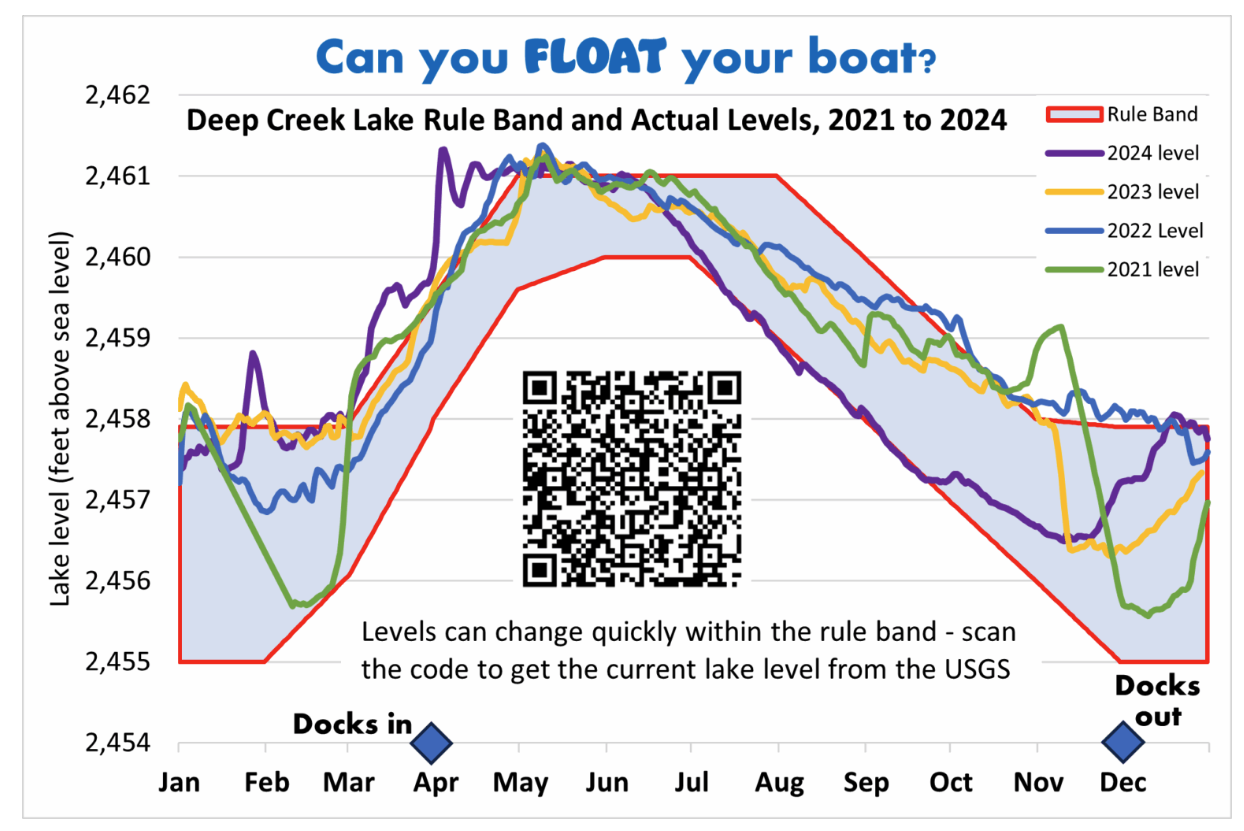
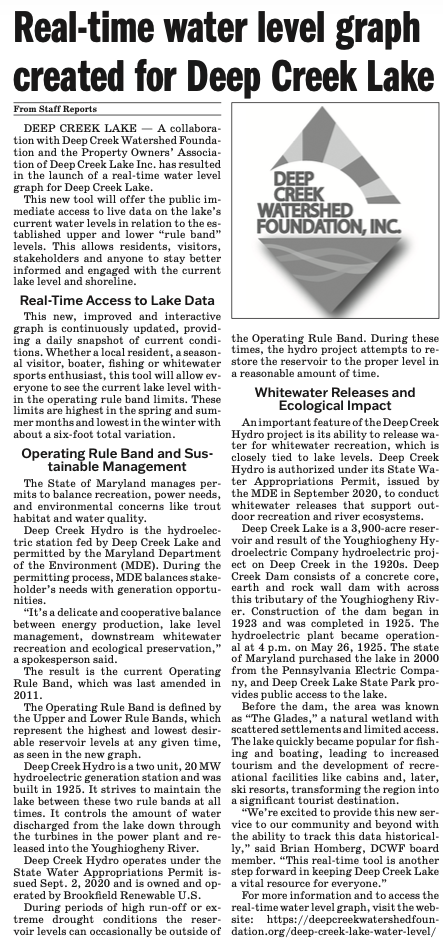
Recently Brookfield Renewable Energy gave a presentation to the stakeholders that included a very informative sharing of the difficulties involved in managing the water levels in Deep Creek Lake.

The Deep Creek Watershed Foundation has been working since its creation to create a management tool to equitably allocate the use of the water in Deep Creek Lake to generate power. Brookfield’s success in managing the resource affects all stakeholders. The management must be carried out within the framework of the Water Appropriation Permit administered by the Maryland Department of the Environment.

The company is required to submit an annual report. For those with time on their hands, you can find the reports at: https://mde.maryland.gov/programs/water/water_supply/pages/deepcreeklakeperiodicreports.aspx. The reports are complete and afford a wealth of data about the power generation operation.

Century Engineering from Baltimore completed the first Water Budget Model for the foundation in June of 2018. Because there was no record of watershed rainfall, no record of water levels, and no record of discharge until two months after the end of the calendar year, a traditional water budget model could not be constructed. They produced a bookkeeping scheme that used the water remaining above the Lower Rule Band on a particular day and subtracted the daily required releases going forward until that water was consumed. When a rainfall event occurs, the lake level goes up and the end of the water day moves forward in time. The foundation distributed that model to the power company.

Starting in 2018, the foundation set to work to provide the necessary data to complete a traditional water budget model. We worked with the United States Geologic Survey to augment the gauges in the watershed area that were in place.

The first one was a recording water level gauge for the lake. Lake management is predicated on the water level relative to the overflow weir at the power company dam, which is assumed to be at elevation 2462. The national level grid is about 1.8 feet different, so we asked USGS to record both datums in the data set. The significant advantage of using them is that the record is kept on the Internet and available to everyone. Given the difference between the elevation measured by survey methods and the staff gauge at the dam, the staff gauge is a single point of failure for managing lake levels according to the permit. The USGS gauge has records back to August 2020.

The foundation sponsored two additional rain measurements to augment the USGS rainfall records at North Glade Run, one at Cherry Creek and the other at Hoyes Run.

The USGS flow gauge on the Youghiogheny River immediately downriver from the power plant discharge has been operating since July 2011. The flow data shows the base flow of the river and the discharges from the power plant. A second USGS gauge was installed upstream at Swallow Falls to evaluate the base flow.

In May 2022, the foundation contacted CEC, a civil and environmental engineer from Pittsburgh, Pennsylvania, to complete the traditional water budget model. The fundamental idea of the water budget model is Water In – Water Out = Change in lake level. With the additional rainfall measurements, the record of water levels, and the record of discharge from the plant for the water year from 1 October 2023 to 30 September 2024, CEC can ascertain the dynamics of the fundamental idea. The goal is to create a model that considers past rainfall, current lake level, and future discharge to produce power per the permit.

Consider an old, clawfoot bathtub full of sand and gravel. Below the drain, attach a recording flow gauge. Water poured into the tub will flow out at a rate and duration based on the amount of water. A record of flow vs. time for one five-gallon bucket dose, a ten-gallon dose, and enough water added to reach the top of the tub plotted on a discharge vs. time graph would calibrate the tub and its contents to predict the rate water will come out of the drain.

The Deep Creek drainage area is like the bathtub. Water runs off, evaporates, and soaks into the ground when it rains. Twelve hours after a rain, all precipitation has run off into the lake or streams. The water that soaks into the ground flows by gravity. Consider the water level in a water supply well. That level is where the groundwater surface is. Most of the water supply wells around the lake have a level higher than the lake, and groundwater flows into the lake. All the lake’s water comes from direct rain, stream flow, or groundwater recharge. An analysis of precipitation records, lake levels, and lake discharges could model the recharge of the lake based on past rainfall.

To be useful to the power plant operator, CEC is creating an Operator User Interface (OUI). The OUI will consist of a computer program that operates behind the scenes to query the USGS websites to retrieve inputs on past rainfall, current water levels, and permitted requirements for discharge. The primary challenge is to model the recharge into the lake from groundwater. The engineer will use the USGS rainfall, flow and water level data collected from October 2023-September 2024 to create the water budget model recharge component.

The OUI works using the same bookkeeping technique as the original limited model. On a given day, the operator enters the date. The program returns the remaining days before the water level goes below the lower rule band. Given the advance notice of the limited water supply, The Maryland Department of the Environment and the plant operator could devise a plan to distribute the remaining available water among the stakeholders equitably.

The plan to deal with the water shortage will make it less of a problem for the various interests in the water in Deep Creek Lake if MDE and the power company put it in place before the need for it!

CEC has a year record and is preparing the OUI now.

2024 Rainfall is up but still a Drought

2024 Rainfall is up but still a Drought

There were ten more inches of rainfall this water year than last year.  The reason for the apparent drought was the rainfall distribution. The graph and supporting data below show that the situation started to develop in April of 2024 when the precipitation fell off.

By April 2024, the watershed had received as much rainfall as it had by September of the previous year. The groundwater recharge relationship incorporated in the completed water budget model will allow the vagaries of rainfall to be accounted for by the mass balance of water in minus water out equals the change in water level. This approach allows the analysis to avoid needing to model such things as evaporation, transpiration, hydraulic transmissivity, etc.

The goal is to model how rainfall moves through the system to allow for a robust predictive model.

The rainfall distribution study for 2022-2023 vs. 2023-2024 at Deep Creek is below. 

2022-23 vs 2023-24 Rainfall

Do you have questions? Call or visit us.

(703) 975-8485

P.O. Box 376
Oakland, MD 21550

Newsletter

Connect With Us

©2026 – Deep Creek Watershed Foundation